
With all the political convention coverage the last two weeks, you might not realize that there was other worthy news during those two weeks. NYT Op-Ed Contributor William Falk keeps tabs on a few stories we may have missed, but that we might be hearing about again pretty soon.
Message in the Music
The United Nations’ 2001 World Conference Against Racism official report declares (on page 10) that (bold my emphasis):
13. We acknowledge that slavery and the slave trade, including the transatlantic slave trade, were appalling tragedies in the history of humanity not only because of their abhorrent barbarism but also in terms of their magnitude, organized nature and especially their negation of the essence of the victims, and further acknowledge that slavery and the slave trade are a crime against humanity and should always have been so, especially the transatlantic slave trade and are among the major sources and manifestations of racism, racial discrimination, xenophobia and related intolerance, and that Africans and people of African descent, Asians and people of Asian descent and indigenous peoples were victims of these acts and continue to be victims of their consequences;
The declaration that the transatlantic slave trade was a crime against humanity was a historic victory for the reparations movement — unfortunately, the tragic 9/11 attacks on New York and Washington D.C. came just a few days after the conference concluded in Durban, South Africa. The news from the conference was effectively buried.
Last week, a group of musicians, artists, and activists from the U.S. Virgin Islands released a roots reggae single that is sure to draw attention back to the issue of reparations in the months to come. The single, simply titled, “We Want Reparations,” will be the new anthem for the St. Croix based African-Caribbean Reparations and Resettlement Alliance (ACRRA). You can listen to the song here.
There are musicians and artists who just like making good music. Then there are musicians and artists who know that once they’ve been given the spotlight and the microphone, they have the responsibility to speak out on issues (and give their audiences information) that affect our communities and societies. This combination of music and activism is more powerful when the music (including the songs, rhythms, melodies, and vocals) and the activism (in lyrics, content, and activities outside of music) show that the musicians/artists are seeking true perfection in what they release to the public. Bottom line, the music has to be good, and the activism sincere. Put them together and you got something special.
These VI roots reggae artists fall into this latter group. Batch, Niyorah, & Danny I provide the lyrics. The music is a collaborative production of the “Zion I Kings”: a collective made up of Laurent “Tippy” Alfred of I Grade Records, “Jah David” Goldfine of Zion High Productions, and Andrew “Moon” Bain of Lustre Kings Productions. Excellent hornlines were provided by Celebrity Horns. Some choice lyrics:
“Look how dem profit from free African labor (African labor)/ Who built up dem cities and dem towns, laid down foundation without compensation (without compensation)/ Never giving nothing to the offsprings of the younger generation”
and:
“They make payment to the Jews, make payment to the Japanese/ Nazi Germany, Communist Soviet, and the Chinese/ Yet you don’t want to give what is due to we/ Haffi protest, petition constantly”
ACRRA says the song offers a unique merging of culture, information, and consciousness purposed to result in international awareness, community education, and activism in the territory. ACRRA’s president, Shelley Moorhead (who is currently on a hunger strike and sit-in on the steps of St. Croix’s Government House seeking support on the issue) puts it best when he says:
“I am uncertain how many people in the world will pay a fee to come and hear me or any other leaders in the territory speak on a given subject. These young, talented local artists and musicians have crafted a ‘word + sound=power equation’ that regularly commands crowds of 10, 20, and 30,000 people in Europe, the United States, South America and the Caribbean who pay upwards of $20 USD to hear what Virgin Islanders are saying about the world’s issues. We are happy to now have them as ambassadors of the Virgin Islands Reparations Movement.”
Late Update: After two weeks, the Governor of U.S.V.I. asks Mr. Moorhead to end his protest on the steps of the Government House. Mr. Moorhead says he is not moving.
Filed under Activism, Anti-Racist, Music, Politics
“Playing the Race Card”
I’m sure I’m not the only one who is annoyed by the phrase, “playing the race card.” Today, the McCain campaign is accusing Barack Obama of using — what conventional wisdom calls — one of the most vile cards in the politics deck.
The idea of playing the race card is just a silly catch-all phrase that is designed to elicit some sort of negative response about the cardholder. Really, what does playing the race card mean? First of all, race is something that will be in this campaign no matter what. There have been 43 white male presidents in U.S. history. Here we have the first black major-party candidate with a real shot of becoming president, do you think that white males will just sit back and let that happen without reminding voters, “uh, excuse me, but he’s black.”
Of course not. There is too much history here. The unfinished business of slavery and its legacy continues to this very day because it was never dealt with fully, and Americans like to pretend that “we have moved beyond that.” So, until we actually deal with our history, race will be a part of the conversation.
Second, what journalists should be doing — instead of hyperventilating over who is “playing the race card” — is having real discussion about the content, or substance, of what is being called “playing the race card.” Most importantly, journalists should ask, who is actually benefiting from the focus of race in the campaign?
In this case, it’s the McCain campaign that will benefit. Their narrative so far about Obama (and amplified by the series of viral smear emails going around) has been all about Obama not being American enough, not patriotic enough, not putting his country first (see McCain’s new tagline), being the quintessential “other” (read: too black, or a Muslim which he is not — not that either of these should preclude one from becoming president).
And one last thing: the notion that the Obama campaign is playing the race card is just ridiculous. Why? Because, when you look at Obama, he is clearly black, or at least not white (though he is half, yet identifies as black; but more on identity/race/perception in the U.S. at some other time). So in a way, I guess Obama is a “walking race card.” Please. Look at history. It does not benefit him to be black when running for the presidency, and even if it did, he would maybe only be on equal ground with a white male at that point.
Late Update: I just want to re-emphasize the new McCain tagline, “COUNTRY FIRST” (refer to why a few paragraphs above), because there is a big kick-off (and free) “Country First” Concert tonight 8/1/08 in Panama City, Florida. This, combined with the negative ads this week, combined with the viral smear emails, is clearly the new unified message strategy. Everyone, repeat after me. The new tagline says it all. Check the screenshot below of the campaign website with the tagline blazed across the top.

"Country First" -- read: "Obama is not quite American enough"
Later Update: The “Country First” Concert with John McCain last night only draws several hundred people, which is only a fraction of what country music star John Rich normally gets at his concerts — usually in the thousands — and remember, this concert was free.
Filed under Media/Journalism, Politics, Race
McCain Far from Straight Talk on Iraq
The good folks over at TPM Election Central have put together what they are calling “The Definitive McCain Iraq Timeline.” The timeline finds many inconsistencies in Senator McCain’s public statements on Iraq.
No matter how many times I watch old video of TV interviews with political figures (largely culled from cable news channels and C-SPAN, edited by motivated citizen journalists and now available on YouTube), I am always amazed when I actually watch the footage. To see all the things people said publicly, edited in rapid montage, really blows my mind sometimes. It makes the inconsistencies stand out that much more.
Jed Lewison of Jedreport.com has edited one such piece on McCain’s Iraq inconsistent statements that really stands out. Check it out, particularly if you think that McCain is truly a straight-talker.
Filed under Politics
A Picture Worth One-Thousand Words
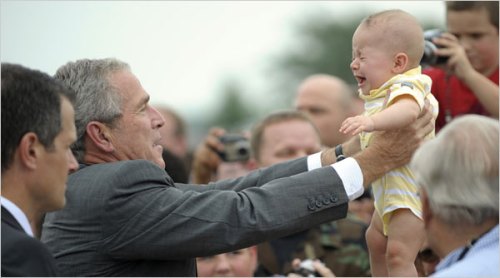
The U.S. and the World after almost 8 years of the Bush Presidency?
Filed under Politics
The Sanitized War Disconnect
The New York Times has a front-page article today by Michael Kamber and Tim Arango about the increasing difficulty photojournalists are having with an American military that is attempting to control graphic images from the war in Iraq. One of the photojournalists featured in the Times’ article is Zoriah Miller, who was recently interviewed on Democracy Now! after he was barred from the Marine Corps for publishing graphic photos showing Marines killed in a suicide attack last month. In the Times’ article, Miller says:
“The fact that the images I took of the suicide bombing — which are just photographs of something that happens every day all across the country — the fact that these photos have been so incredibly shocking to people, says that whatever they are doing to limit this type of photo getting out, it is working.”
The Times’ article says that “searches and interviews turned up fewer than a half-dozen graphic photographs of dead American soldiers,” and, by a recent count, only a handful of Western photographers are covering the war today.
One is forced to wonder, as Miller implies above, if the public saw more of these photos — which in reality show the true nature of war and the consequences of violence — would there be the same amount of passivity regarding the ongoing unpopular war?
Very Late Update: The New York Times’ Public Editor weighs in on the details of the Times’ decisions to publish war photographs.
Filed under Media/Journalism, Politics

 Notes and Beats